 [Nederlandse
versie] [Nederlandse
versie] |
<Gesta>
|
Celesta Robot Research project on the development of new tools for musical expressionnt |
|
<Gesta>
an automated celesta dr.Godfried-Willem RAES 2026- |
| [Nederlandse
versie] |
<Gesta>
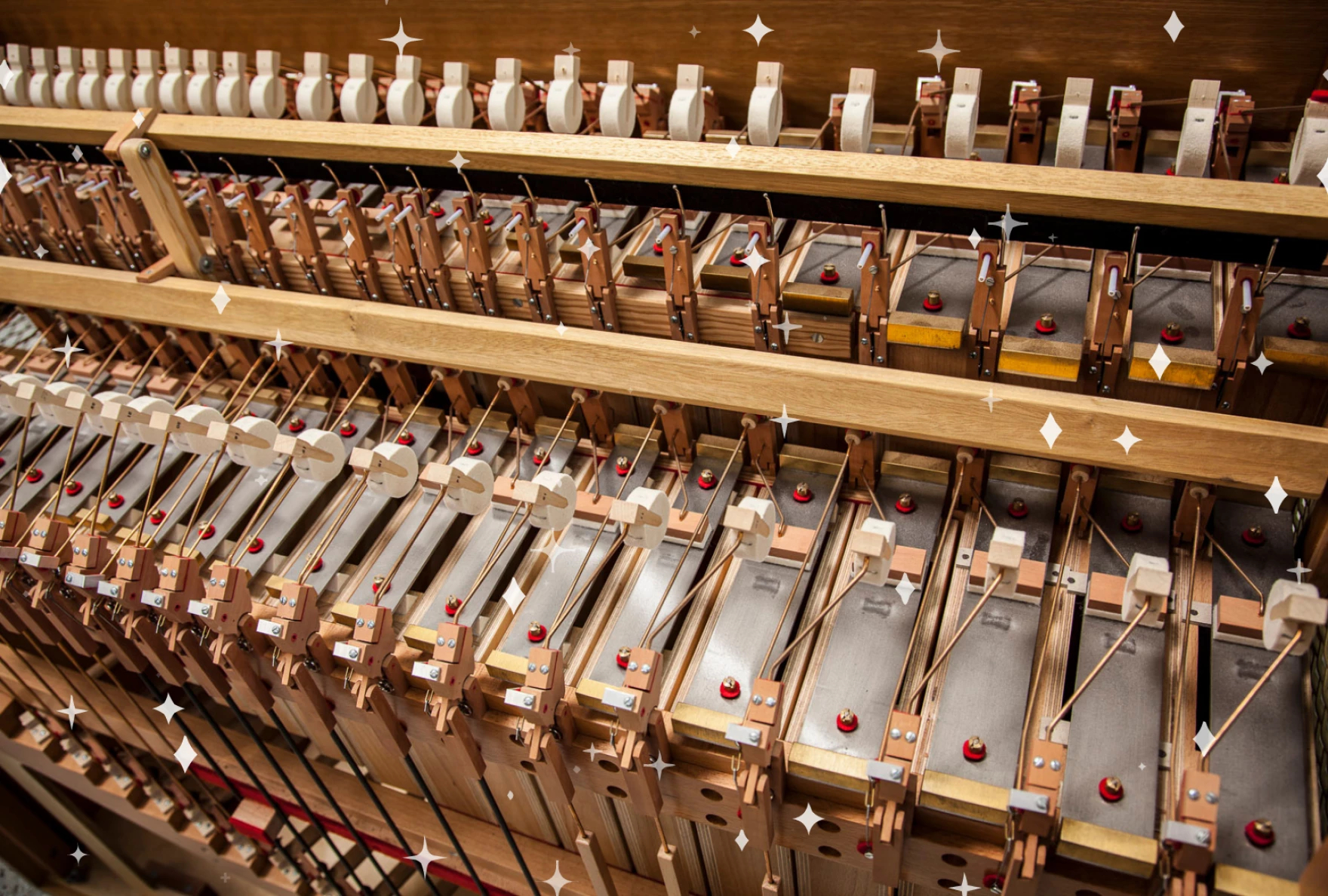
This instrument is a four octave celesta. The original instrument had a piano-like keyboard as well as a single sustain pedal.
Source code and hexdumps for the PIC microcontrollers:
| board | processor | source code | hex-dump | PCB file |
| Hub/parser | 18F2620 | Pianet_Hub.bas | Pianet_hub.hex | PCB_Pianet_Hub.gif |
| Board1 | 18F4620 | Pianet_PH.bas | Pianet_PH1.hex | PCB_12PH.gif |
| Board2 | 18F4620 | id. | Pianet_PH2.hex | id. |
| Board3 | 18F4620 | id. | Pianet_PH3.hex | id. |
| Board4 | 18F4620 | id. | Pianet_PH4.hex | id |
| Board5 | 18F4620 | id. | Pianet_PH5.hex | id. |

Note-off, no release
Note-on, velocity implemented
Key pressure: used for automatic note repeats. Each note can be programmed with an individual repetition rate. Key pressure can also be used to modify light flashing speed.
Lights:
Controllers implemented:
#30: Global repetition rate controller. Value 0 disables repetitions. Note that repetitions will be synchronous and in sync only if the notes to which they are applied start at the same time. By default set to OFF.
#66: Power on/off switch. This resets controllers and switches the power supplies for the solenoids. Value 0 switches OFF, any other value is ON. Switching this controller also resets all controllers to their default values on cold boot.
#69: Switches automation of the lights on or off. Values 1 to 7 select different light mappings. Value 0 switches the mechanism off. By default, automation is switched ON.
#123: All notes OFF. (Includes the lights).
Program change: not implemented
Channel aftertouch: not implemented
Pitch Bend: not implemented
Technical specifications:
Design and construction: dr.Godfried-Willem Raes
Collaborators on the construction of this robot:
Music composed for <Gelesta>:
none specific sofar. However, <Gelesta> can sometimes be used for concerts at venues that do not have a piano available. It also can replace the spinet (<Spiro> as well as <Sper>) in quite a few orchestrations.
Pictures taken during the construction in our workshop:
| Back to Main Logos page:index.html | To Godfried-Willem Raes personal home page... | To Instrument catalogue |  |
<Gelesta>
Dit automatiseringsprojekt ging van start op vraag van Alain Van Zeveren. Het maakte oorspronkelijk dan ook geen deel uit van ons grote projekt rond de bouw en ontwikkeling van het robotorkest bij Stichting Logos. De belangrijkste reden waarom voor dit projekt geen plaats was binnen het robotorkest, heeft te maken met het werkingsprincipe van dit instrument dat, hoewel het geluid veroorzaakt wordt door vrij trillende stalen tongen, immers onmogelijk kan klinken zonder toepassing van een externe versterker en dito luidspreker. De afwezigheid van luidsprekers voor versterking was nu eenmaal een paradigma achter het Logos robotorkest.
Niettemin, omdat na de automatisering van het Hohner pianet, het projekt wat verweesd in onze werkplaats was achtergebleven, beslisten we het toch tot een autonome robot uit te bouwen en af te werken. Dus ontwierpen we een deugdelijk wielstel met kruisdisselbesturing evenals een versterkersystreem uitgerust met twee antieke University Sound -de voorloper van JBL-Altec- speakers. De <Pianet> robot kan nu worden ingezet op plaatsen waar een beroep gedaan wordt op het robotorkest maar waar geen vleugelpiano aanwezig is. Ook als vervanger voor het spinet, is het erg geschikt.
Bouwdagboek - Construction & Research Diary:
| (Terug) naar logos-projekten: | Terug naar Logos' index-pagina: | Naar Godfried-Willem Raes personal homepage... | Naar katalogus instrumenten | |
M&M orkest |
Last update: 2026-07-12 by Godfried-Willem Raes
The following information is not intended for the general public nor for composers wanting to make use of the <Pianet> robot, but is essential for maintenance and servicing of the robot by our clients and collaborators. It also might be usefull for people that want to undertake similar projects.
Technical drawings, specs and data sheets:
Power supplies:
Fuse in the power entry: 4 A. A spare fuse can be found in the little drawer.
Wiring & circuit details midihub board:
By changing the jumper on this board it is possible to select between parsed midi mode (1 ms delay) and direct mode. Direct mode may lead to much higher jitter on the timing precision, depending on overall midi density. The protection diodes (1N4007) for inductive loads have been ommitted in the practical realisation as the mosfets are only used to switch lights here.
PCB for this board:
Circuit details solenoid driver board:
board 1 using 12 IRF620 MOSFET's for the pulses
board 2 using 10 IRF530 MOSFET's for the pulses, 1 IRF540, 1 IRF1310
boards 3 to 5 using 12 IRF3710 for the pulses
All boards use IRL640 for the holds.
summary of data-sheet values for MOSFET's used:
| type | Umax | Imax | Ug | RdsON | Ci |
| IRF530 | 100V | 14A | 10V | 0.18 Ohm | |
| IRF540 | 100V | 28A | 10V | 0.08 Ohm | 1.7nF |
| IRF620 | 200V | 5A | 10V | 0.8 Ohm | |
| IRF1310 | 100V | 24A | 10V | 0.036 Ohm | 1.9nF |
| IRF3710Z | |||||
| IRL640 | 200V | 18A | 5V | 0.18 Ohm | 1.7nF |
| IRLZ34 | 55V | 30A | 5V | 0.046 Ohm | 880pF |
| FQPF20N06E | 60V | 15A | 3V |
If repair and replacement is required, all N-channel mosfet's can be replaced with IRL640 types.
Solenoids: Intertec ITS-LZ-1949-D-12V. Datasheet. Nominal voltage: 12V , Power: 7W (Hence Rdc= 20.57 Ohm). With the 9V hold-voltage only, the current drawn is 437 mA. During the velo-pulse, current rises to 1.6 A.
Mechanical construction drawings and welding plan:
Tentative cost calculation:
| tubular solenoids: |
60
|
13,50-
|
810,-
|
| PCB's P/H boards: |
5
|
250,-
|
1.250,-
|
| Hub board |
1
|
200,-
|
200,-
|
| Power supply: 9V - 11A |
110,-
|
110,-
|
|
| Power supplies 24V - 6A / 9A |
210,-
|
210,-
|
|
| Chassis Vorsetzer |
200,-
|
200,-
|
|
| Konnektors 2pole Weidmueller |
60
|
1,60-
|
96,-
|
| Ettinger M3 shock absorbers |
20
|
3,60-
|
72,-
|
| Rubber fingers |
60
|
2,80-
|
168,-
|
| Metal plated wood |
1
|
8,20-
|
8,20-
|
| M6 bakeliet knoppen |
4
|
2,70-
|
10,80-
|
| Material cost estimate |
3.800,-
|
Labor (estimated at 4 weeks): 6.300,-
Total estimated cost: 10.100,- [16.12.2021]
Additional costs for the construction of the trolley and the amplifier system:
6.000,-
Total estimated end cost: 16.100,- Euro.
References:
Raes, Godfried-Willem, "Expression control in musical automates", 1977/2026,


