|
Celesta Robot Research project on the development of new tools for musical expressionnt |
|
<Gesta>
an automated original Victor Mustel celesta dr.Godfried-Willem RAES 2026- |
|
Celesta Robot Research project on the development of new tools for musical expressionnt |
|
<Gesta>
an automated original Victor Mustel celesta dr.Godfried-Willem RAES 2026- |
 [Nederlandse
versie] [Nederlandse
versie] |
<Gesta>
This automated instrument is based on an antique four octave celesta. The original
instrument, an original Victor Mustel dating from the end of the 19th century,
had a piano-like keyboard as well as a single sustain pedal. The celesta has
been given a patent in France in 1886 on the name of August Mustel, Victor's
son. Here is a drawing from that patent: 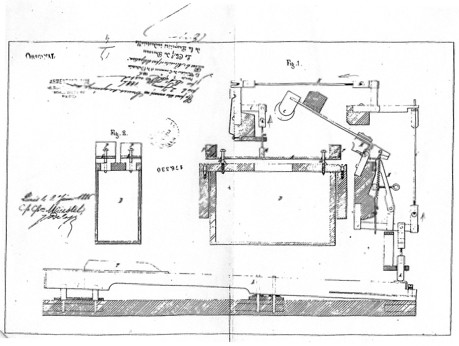 The
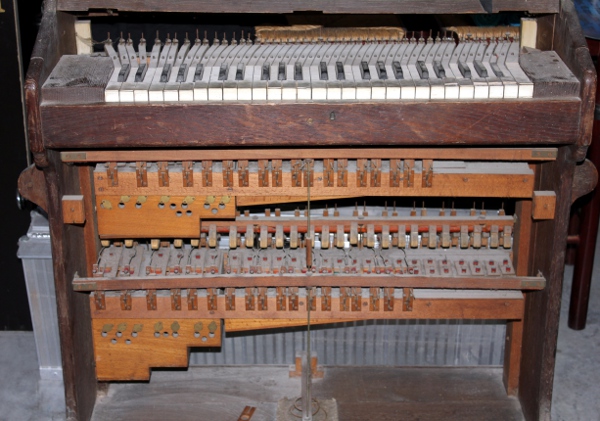
sound source is a series of tuned steel plates suspended above wooden resonators
tuned to the fundamental. The mechanism is very much piano-like although the
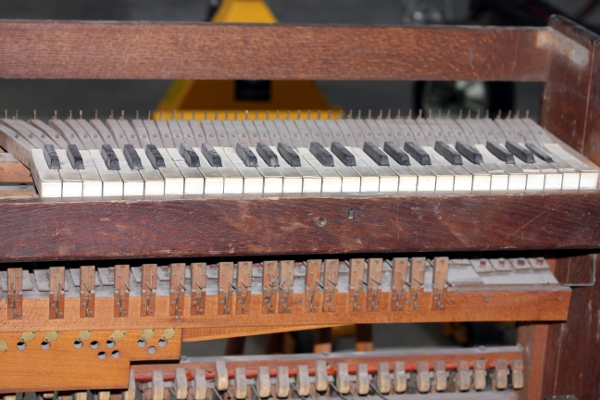
dynamic range is very limited in this case. Here is a picture of the instrument
as we received it in 2026.
The
sound source is a series of tuned steel plates suspended above wooden resonators
tuned to the fundamental. The mechanism is very much piano-like although the
dynamic range is very limited in this case. Here is a picture of the instrument
as we received it in 2026.
 The first thing we had
to do, of course, was analysing the exact way the instrument functions. An animated
gif taken from the site of the only one modern builder of celesta's (Scheidmeyer,
Germany), reveals a lot:
The first thing we had
to do, of course, was analysing the exact way the instrument functions. An animated
gif taken from the site of the only one modern builder of celesta's (Scheidmeyer,
Germany), reveals a lot: 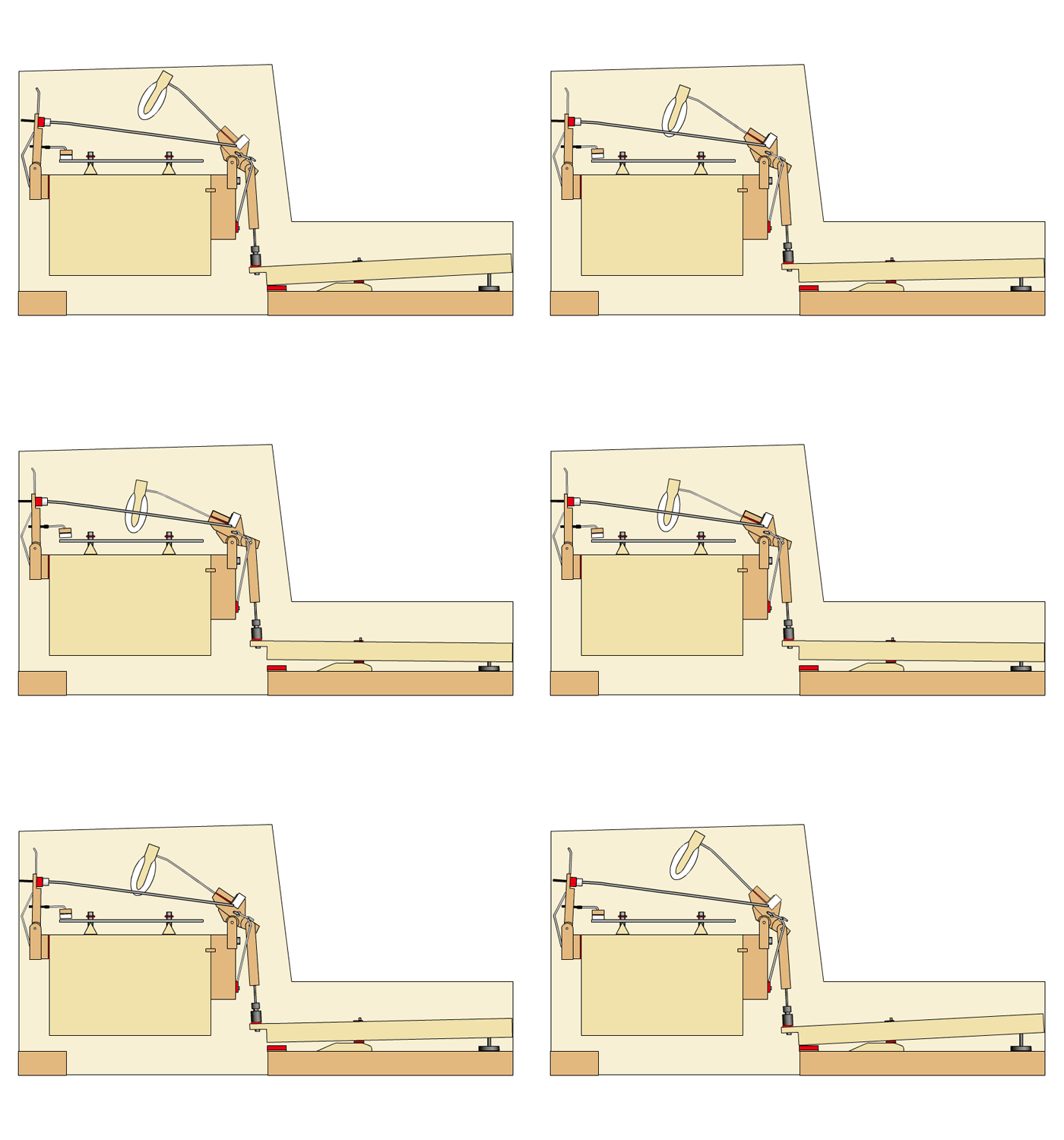 However, on the original instrument the keyboard is placed above the sound bars
and not below them as in the animation. At rest, the felt damper lies flat on
the sound bar. The mechanism operates such as to first lift the damper, just
before the hammer can beat the sound bar. The hammer bounces back after the
stroke, but as long as the key is held down, the damper remains lifted and thus
the bar is free to resonate over its resonator. Here is a more detailed view
on the lower side of the mechanism:
However, on the original instrument the keyboard is placed above the sound bars
and not below them as in the animation. At rest, the felt damper lies flat on
the sound bar. The mechanism operates such as to first lift the damper, just
before the hammer can beat the sound bar. The hammer bounces back after the
stroke, but as long as the key is held down, the damper remains lifted and thus
the bar is free to resonate over its resonator. Here is a more detailed view
on the lower side of the mechanism: 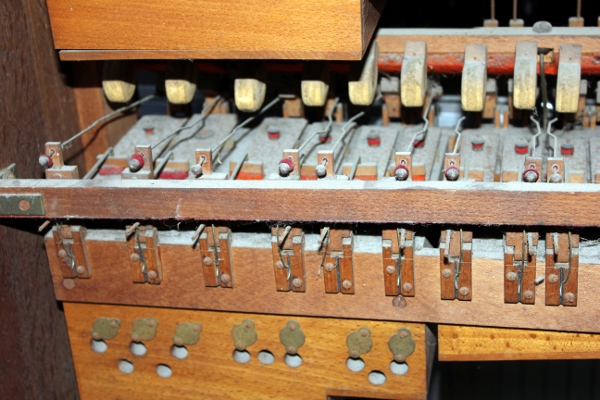 On the highest octave, there are no dampers mounted as can be seen here:
 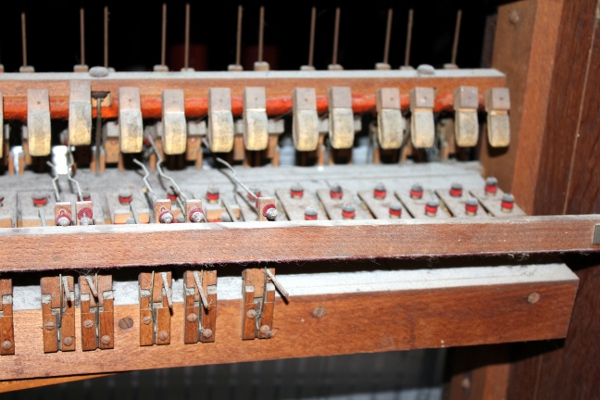 .
The pedal is used to lift all the dampers together. That our instrument is an
authentic Mustel is evident from the signature and series number found on the
backside of the instrument:
.
The pedal is used to lift all the dampers together. That our instrument is an
authentic Mustel is evident from the signature and series number found on the
backside of the instrument: 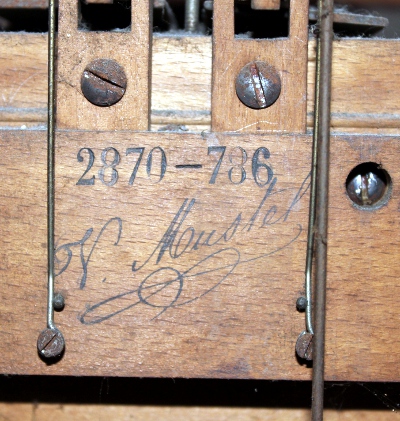
Automating such an instrument at first sight looks like a straightforward task, as it looks like the design of the piano Vorsetzer can be duplicated. However, after a few experiments along that line it became clear that this was not an optimal solution as we were confronted with a lot of unwanted noises originating from the mechanism. The dynamic range of the celesta being pretty limited, this became all the more objectionable. Thus we decided to leave out the entire keyboard and all the tractures starting from it and leading to the mechanism. Also the mechanism lifting the damper before striking was removed. Instead we provided damper solenoids for each plate activating felt dampers. As in our implementation, the sound bars are free at rest, we do not need a delay anymore between a strike command and the actual hitting of the hammer. The dampers are activated on reception of a note-off command. The dampers can be globally disabled, thus implementing the function of the original pedal mechanism.
For the power supply in this robot, we went for a really antique but still
extremely sturdy design, based on the magnetic amplifier and using a saturated
core transformer. We did some research and experiments around that concept in
2015 and still had an experimental realisation waiting for an application on
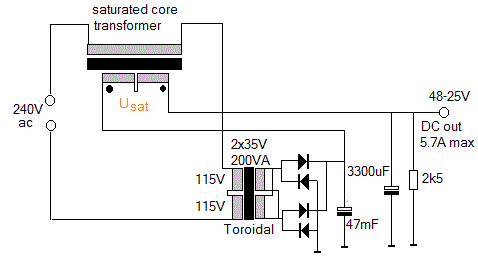
the shelves in our lab. Here is an
article we wrote on the subject. Here is the circuit drawing of our realisation:
 The
saturated core transformer -recycled from telephone company equipment dating
from the early sixtees- looks like this:
The
saturated core transformer -recycled from telephone company equipment dating
from the early sixtees- looks like this: 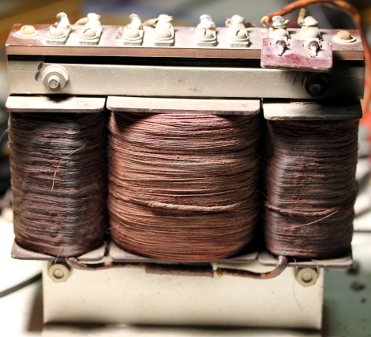
Source code and hexdumps for the PIC microcontrollers:
| board | processor | source code | hex-dump | PCB file |
| Hub/parser | 18F2620 | |||
| Board1 | 18F4620 | |||
| Board2 | 18F4620 | |||
| Board3 | 18F4620 | |||
| Board4 | 18F4620 | |||
Note-off, the release byte may be used to steer the damping force. Note that the highest octave does not have dampers.
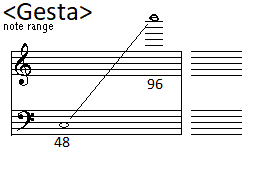
Note-on, velocity implemented. Note range 60 to 108, 4 octaves.
Key pressure: used for automatic note repeats. Each note can be programmed with an individual repetition rate. Key pressure can also be used to modify light flashing speed.
Lights:
Controllers implemented:
#7: Velocitry scaling (under consideration)
#19: damping force on release if note-off with release byte is not used.
#30: Global repetition rate controller. Value 0 disables repetitions. Note that repetitions will be synchronous and in sync only if the notes to which they are applied start at the same time. By default set to OFF.
#64: Pedal on-off switch. Default is OFF, thus enabling the dampers.
#66: Power on/off switch. This resets controllers and switches the power supplies for the solenoids. Value 0 switches OFF, any other value is ON. Switching this controller also resets all controllers to their default values on cold boot.
#69: Switches automation of the lights on or off. Values 1 to 7 select different light mappings. Value 0 switches the mechanism off. By default, automation is switched ON.
#123: All notes OFF. (Includes the lights and the dampers.
Program change: not implemented
Channel aftertouch: not implemented
Pitch Bend: not implemented
Technical specifications:
Design and construction: dr.Godfried-Willem Raes
Collaborators on the construction of this robot:
Music composed for <Gesta>:
none specific sofar. However, <Gesta> can often be an alternative for the vibraphone (<Vibi>).
orchestrations using <Gesta>:
Tchaikovsky, dance of the sugar fairy, from the Nutcracker. (original part for celesta!)
James Ensor 'La gamme d'amour' (in the works, if we can get the required support for this production).
| Back to Main Logos page:index.html | To Godfried-Willem Raes personal home page... | To Instrument catalogue |  |
<Gesta>
Op ons verlanglijstje stond het instrument helemaal niet. Immers een celesta is een behoorlijk duur instrument met een vrij beperkte dynamiek en wordt eigenlijk in niet zo gek veel muziek gebruikt. Iedereen kent natuurlijk wel de weinig vernieuwende dans van de suikerfee uit de notenkraker van Tchaikovsky (1892) en de veel latere 'muziek voor strijkers en celesta' van Bela Bartok (1936), maar daar blijft het veelal wel bij. Alleen grote orkesten, hamonien, operahuizen en konservatoria plegen er dan ook eentje te hebben. Louter organologisch gezien is het een metalofoon met stalen klanklatten opgehangen op twee nodale punten. Onder de latten zijn resonatoren in hout geplaatst, waarbij elke resonator twee klankstaven bedient. Eigenlijk dus zowat het midden houdend tussen Helmholtz-resonatoren en simplele trogresonatoren. Die resonatoren kunnen min of meer gestemd worden middels houten sleuven waarmee een ronde opening minder of meer gesloten kan worden. De kwaliteitsfaktor van de resonatoren is niet erg hoog en zeker inferieur aan wat we aantreffen op de vibrafoon, maar dat is dan weer een instrument van veel recentere makelij. De oudste vibrafoons werden in 1916 gebouwd door Hermann Winterhoff (1902-1930) en hadden net zoals de celesta, stalen klankstaven. De aluminium staven op alle moderne vibrafoons werden in 1927 bedacht door Henry Schluter voor de firma Deagan. De resonatoren op vibrafoons zijn ronde buizen gesloten aan een kant. Omdat de stalen klanklatten van de celesta geen uitholling hebben aan de onderzijde, is hun spektrum van nature uit heel wat minder harmonisch dan dat van de vibrafoon. Die inharmoniciteit wordt evenwel getemperd door de resonatoren die vooral de grondtoon versterken. Heel wat ouder, maar afkomstig uit Oosterse kulturen, zijn de genders uit het gamelan orkest. Die hebben bronzen klanklatten en cilindrische bamboe resonatoren. De originele celesta is een uitvinding van August en/of Victor Mustel en had aanvankelijk een bereik van vier oktaven. Het instrument klinkt een oktaaf hoger dan de notatie, waarvoor een systeem met fa- en solsleutel wordt gebruikt zoals voor de piano:
Hoewel een slaginstrument,
worden partijen voor de celesta in het symfonisch orkest zo goed als steeds
gespeeld door een pianist.
We kregen een originele Victor Mustel celesta in een erg verwaarloosde staat. Uiteraard bestond onze eerste ingreep erin het instrument grondig te bestuderen en een staat op te maken van de nodige ingrepen om het instrument terug goed aan het klinken te brengen. Onze aanvankelijke idee om de automatiserfing aan te pakken naar analogie met wat we deden voor de player piano en voor de klavecimbels bleek na enkele proefnemingen volkomen onwerkbaar vanwege de vele bijgeluiden veroorzaakt door het mechanisme. We verwijderden dan maar het gehele toetsenbord en experimenteerden met het aanslaan van de hamers achter hun draaipunt na het verwijderen van alle trakturen tussen toetsenbord en mechanisme. Ook dit leverde echter geen aanvaardbaar resultaat op. Dan maar beslist om het door het oorspronkelijk mechanisme geautomatiseerd optillen van de dempers voor het aanslaan van de klankplaten te elimineren en voor het dempen volkomen onafhankelijke elektromagneten in te zetten. Het aanslaan moet dan -met behoud van de originele vilten hamers- van bovenuit gebeuren met cilindrische solenoiden. We hadden nog ruim voldoende Lucas-Ledex solenoiden in voorraad van hetzelfde type dat we ook gebruikten voor <Vibi> en voor de tweede playerpiano <pp2>. Omdat de totale massa van de hamers en de ankers van de solenoiden moet afnemen met toenemende toonhoogte, holden we de ankers proportioneel uit op de draaibank.
Bouwdagboek - Construction & Research Diary:
 De
stemming blijkt overeen te stemmen met La 440Hz wat toch zou wijzen op een
geen al te oude leeftijd. De celesta werd in 1886 gepatenteerd door August
Mustel, dus ouder kan het in elk geval al niet zijn. Aan de achterzijde van
het instrument ontdekten we een handtekening: Victor Mustel: Victor
was de vader van August.
De
stemming blijkt overeen te stemmen met La 440Hz wat toch zou wijzen op een
geen al te oude leeftijd. De celesta werd in 1886 gepatenteerd door August
Mustel, dus ouder kan het in elk geval al niet zijn. Aan de achterzijde van
het instrument ontdekten we een handtekening: Victor Mustel: Victor
was de vader van August. 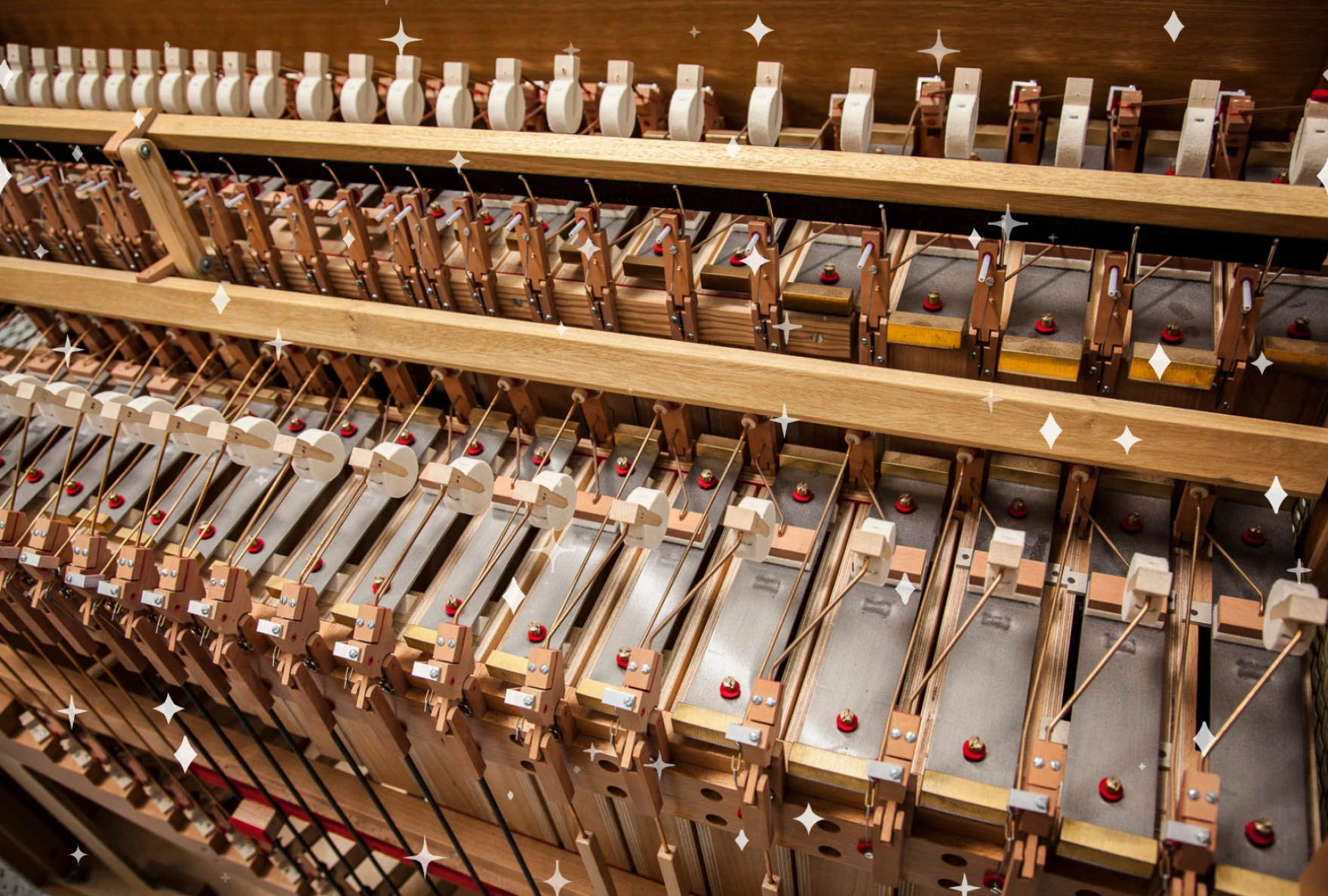
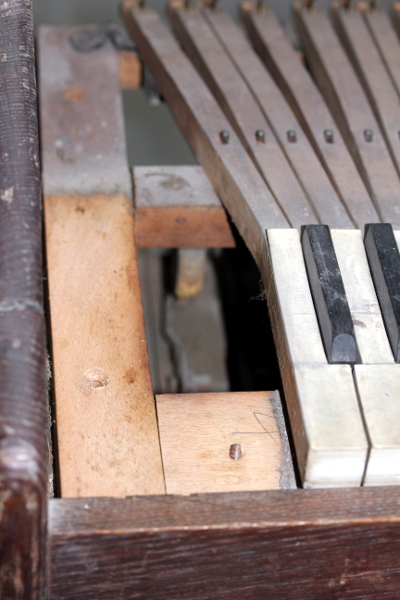 En, hier de rechterkant:
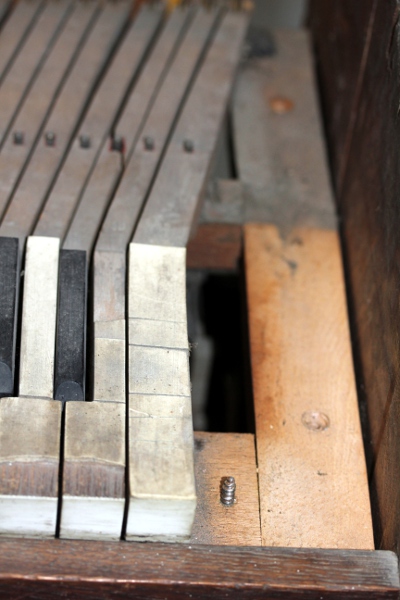 Daarvoor moesten we
uiteraard alle trakturen aan de bovenzijde losmaken.
Daarvoor moesten we
uiteraard alle trakturen aan de bovenzijde losmaken.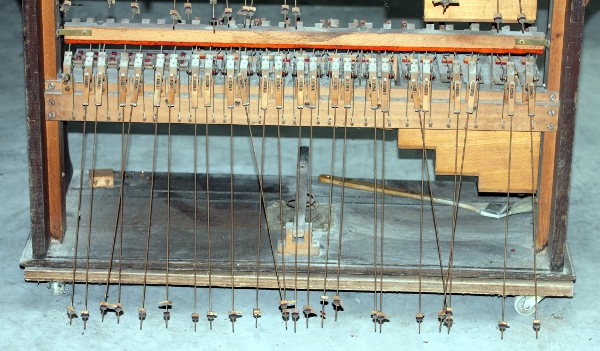
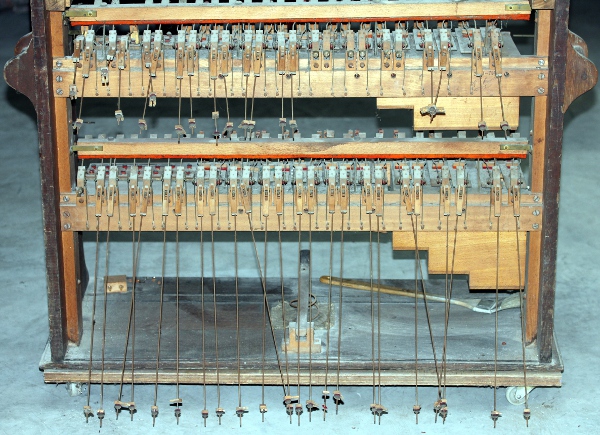
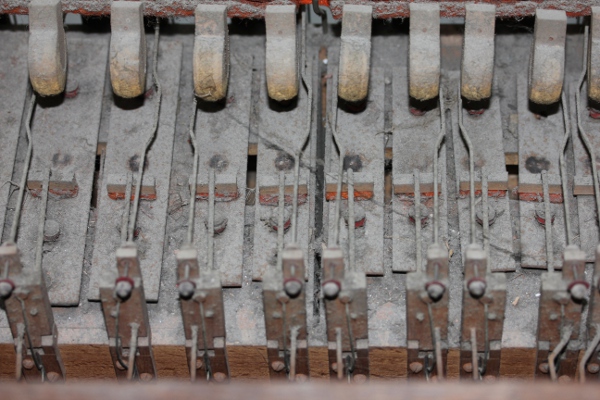 Aan de hoge kant, al evenveel stof:
 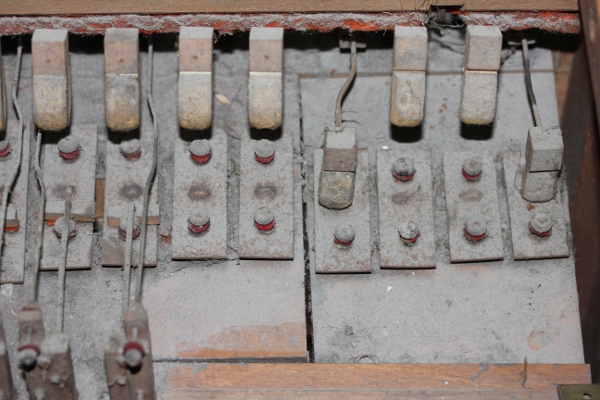 en
ook een tweetal kapotte hamers. Zoals men zal zien ontbreken aan deze kant
dempers.
en
ook een tweetal kapotte hamers. Zoals men zal zien ontbreken aan deze kant
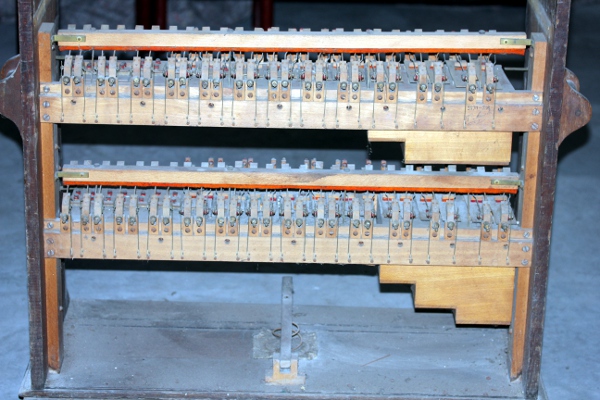
dempers. 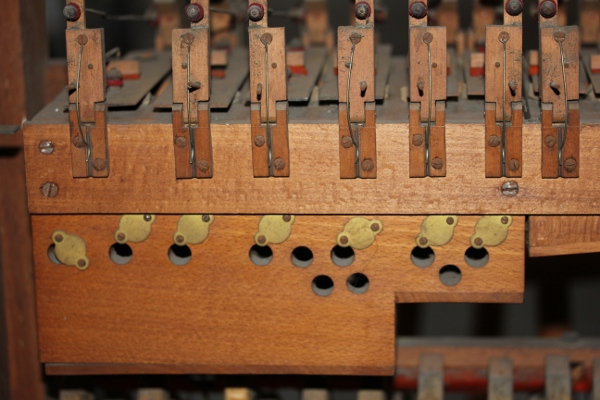 Achterzijde, oppervlakkig ontstoft en zonder trakturen naar het klavier:
 Budgettering van het bouwprojekt, aangezien we het willen inzetten voor een
produktie rond het werk 'La Gamme d'Amour' van James Ensor. Voor deze produktie
willen we immers een projektsubsidie aanvragen.
Budgettering van het bouwprojekt, aangezien we het willen inzetten voor een
produktie rond het werk 'La Gamme d'Amour' van James Ensor. Voor deze produktie
willen we immers een projektsubsidie aanvragen.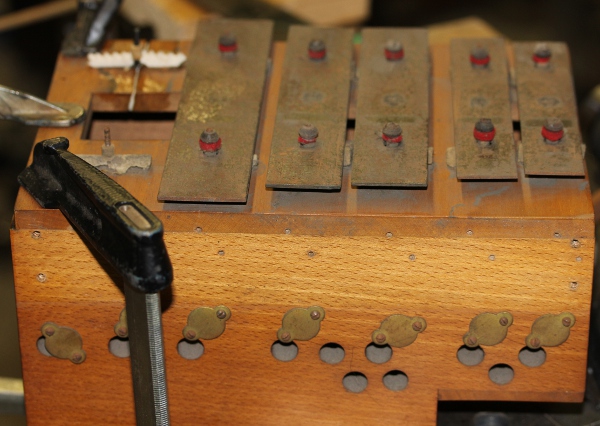
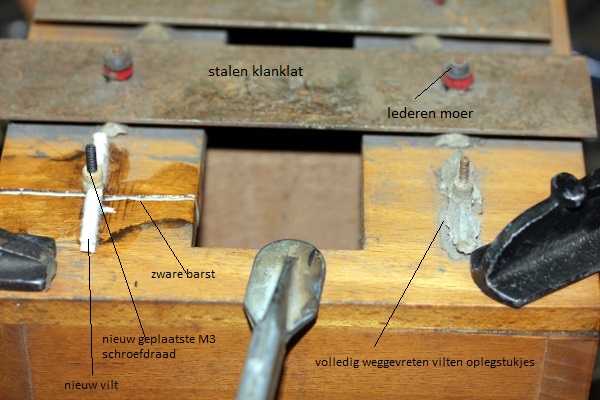 Die
moeten we allemaal met witte houtlijm dichtmaken, anders werken de resoinatoren
niet goed meer. Ook in het hout gebruikt voor de stemmingssleuven onderaan
blijken ernstige barsten te zitten.
Die
moeten we allemaal met witte houtlijm dichtmaken, anders werken de resoinatoren
niet goed meer. Ook in het hout gebruikt voor de stemmingssleuven onderaan
blijken ernstige barsten te zitten.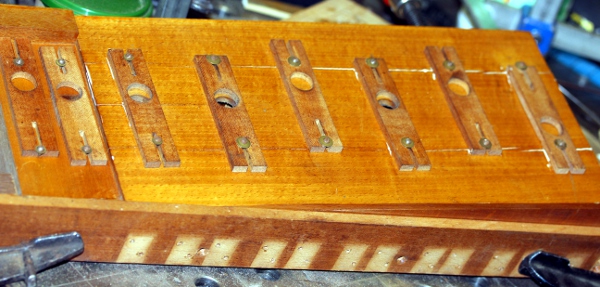
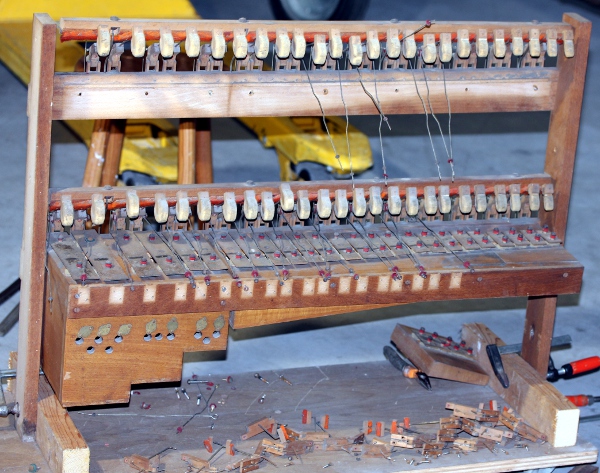 De hele bovenste rij klankstaven en resonatoren opgepoetst en gerestoreerd.
Alvast wat hamertjes gereed gemaakt. Het belooft een klus van meerdere dagen
te worden.
De hele bovenste rij klankstaven en resonatoren opgepoetst en gerestoreerd.
Alvast wat hamertjes gereed gemaakt. Het belooft een klus van meerdere dagen
te worden.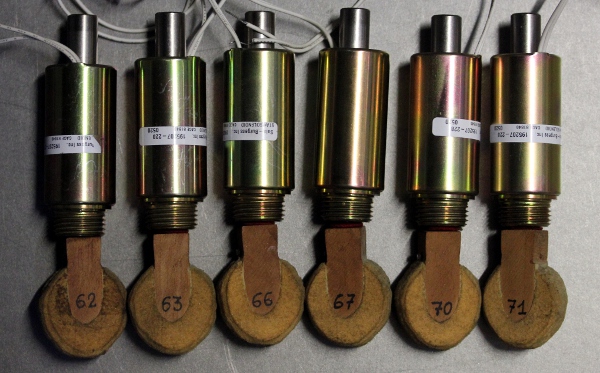 De kogel is
door de kerk: van het originele mechanisme gaan we helemaal niets meer overhouden.
Zowel hamers als dempers bouwen we helemaal nieuw. Aan de oorspronkelijke
klank evenwel, raken we niet.
De kogel is
door de kerk: van het originele mechanisme gaan we helemaal niets meer overhouden.
Zowel hamers als dempers bouwen we helemaal nieuw. Aan de oorspronkelijke
klank evenwel, raken we niet.| noot | uitholling | anker massa | hamer gewicht |
| 60 - onder | 0 | 31.2 g | 3.5 g |
| 61 - onder | 0 | ||
| 62 - boven | 0 | ||
| 63 - boven | 0 | ||
| 64 - onder | 0 | ||
| 65 - onder | 0 | ||
| 66 - boven | 0 | ||
| 67 - boven | 0 | ||
| 68 - onder | 0 | ||
| 69 - onder | 0 | ||
| 70 - boven | 0 | ||
| 71 - boven | 0 | ||
| 72 - onder | 0 | ||
| 73 - onder | 0 | ||
| 74 - boven | 0 | ||
| 75 - boven | 0 | ||
| 76 - onder | 0 | ||
| 77 - onder | 0 | ||
| 78 - boven | 0 | ||
| 79 - boven | 0 | ||
| 80 - onder | 5 | ||
| 81 - onder | 5 | ||
| 82 - boven | 5 | ||
| 83 - boven | 5 | 2.2 g | |
| 84 - onder | 10 | ||
| 85 - onder | 10 | ||
| 86 - boven | 10 | ||
| 87- boven | 10 | ||
| 88 - onder | 15 | ||
| 89 - onder | 15 | ||
| 90 - boven | 15 | ||
| 91 - boven | 15 | ||
| 92 - onder | 20 | ||
| 93 - onder | 20 | ||
| 94 - boven | 20 | 2.0 g | |
| 95 - boven | 20 | ||
| 96 - onder | 25 | ||
| 97 - onder | 25 | ||
| 98 - boven | 25 | ||
| 99 - boven | 25 | ||
| 100 - onder | 30 | ||
| 101- onder | 30 | ||
| 102- boven | 30 | ||
| 103- boven | 30 | ||
| 104- onder | 35 | ||
|
105 - onder |
35 | ||
| 106 -boven | 35 | ||
| 107 -boven | 35 | 1.0 g | |
| 108 -onder | 35 mm | 15 g | 1.0 g |
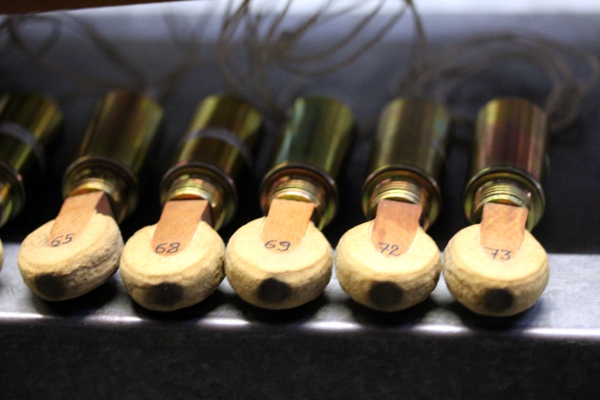 De gaten in de harmers boorden we op 2.5 mm en daarin tapten we schroefdraad
M3, erg makkelijk in hout natuurlijk...
De gaten in de harmers boorden we op 2.5 mm en daarin tapten we schroefdraad
M3, erg makkelijk in hout natuurlijk... 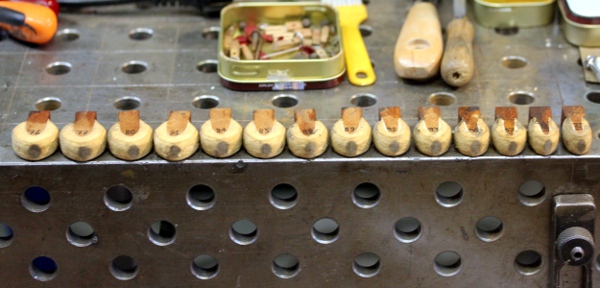
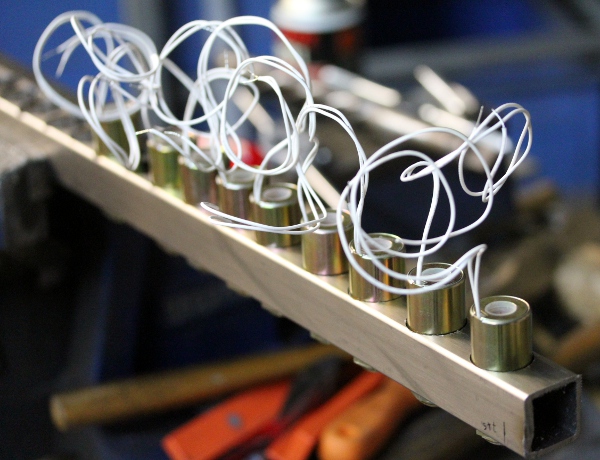 De
gaten aan de kant van de moer (ca. 1/2" draad) boren met een 19 mm boor,
de gaten aan de invoerkant (daar moet de inwendige lasnaad van het kokerprofiel
zitten!) met boormaat 27.5 mm.
De
gaten aan de kant van de moer (ca. 1/2" draad) boren met een 19 mm boor,
de gaten aan de invoerkant (daar moet de inwendige lasnaad van het kokerprofiel
zitten!) met boormaat 27.5 mm.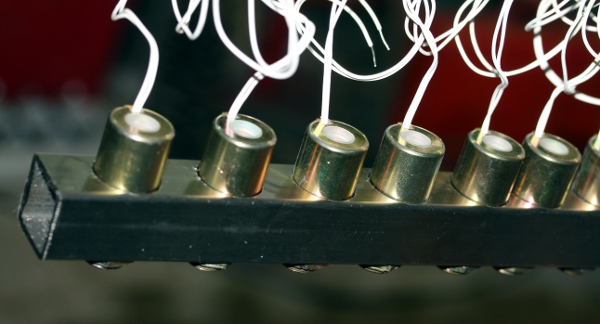 Die boren hebben we nog liggen met een MK3 morse conus.
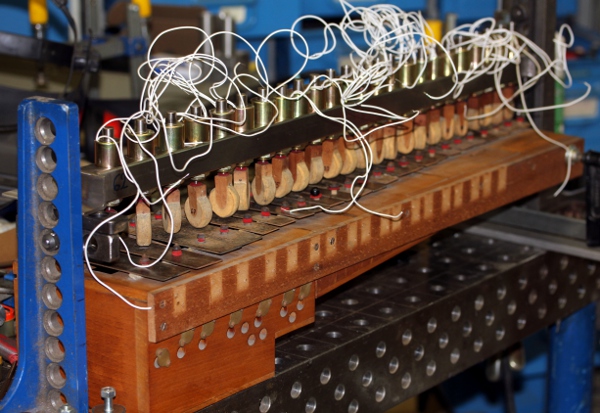 De hamers
moeten duidelijk bijgesneden worden op het vilt waar ze elkaar nog kunnen
raken.
De hamers
moeten duidelijk bijgesneden worden op het vilt waar ze elkaar nog kunnen
raken.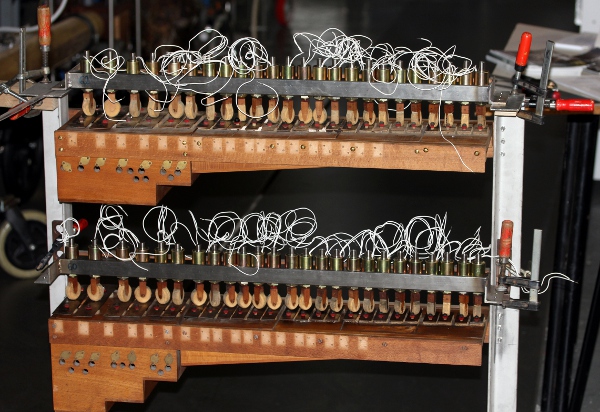
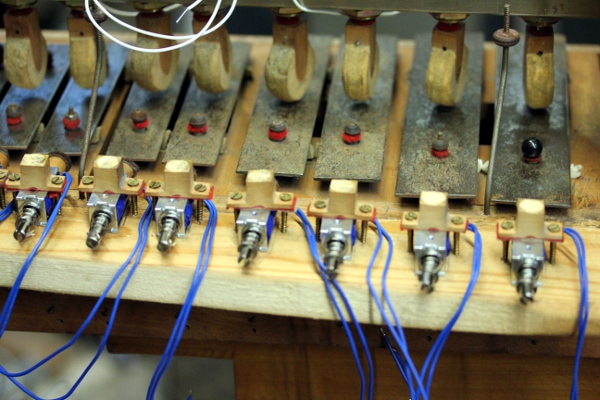 Hiervoor
gebruiken we onderdelen gerecycleerd uit een mekaniek van een oude buffetpiano.
Hier is een detail:
Hiervoor
gebruiken we onderdelen gerecycleerd uit een mekaniek van een oude buffetpiano.
Hier is een detail: 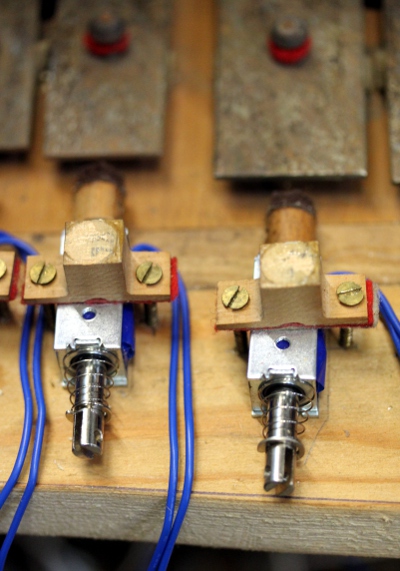 In de stukjes rondhout tapten we 6 mm diep een M3 schroefdraad, na zuiver
centrisch boren met 2.5 mm op de draaibank. Op die stukje kleven we het dempervilt.
De brugjes voor de montage van de elektromagneetjes zijn eveneens afkomstig
uit de dempers van de oude buffetpiano.
In de stukjes rondhout tapten we 6 mm diep een M3 schroefdraad, na zuiver
centrisch boren met 2.5 mm op de draaibank. Op die stukje kleven we het dempervilt.
De brugjes voor de montage van de elektromagneetjes zijn eveneens afkomstig
uit de dempers van de oude buffetpiano.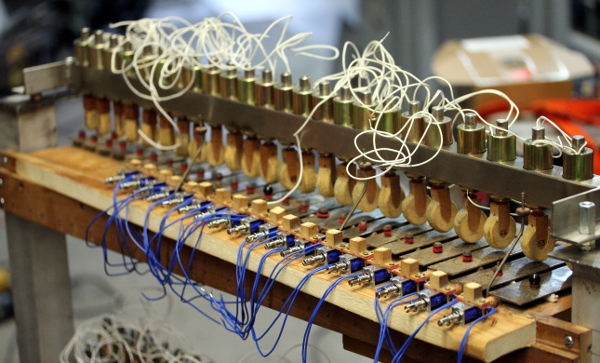 Dat zijn er 18 stuks. Het bovenste oktaaf heeft geen dempers.
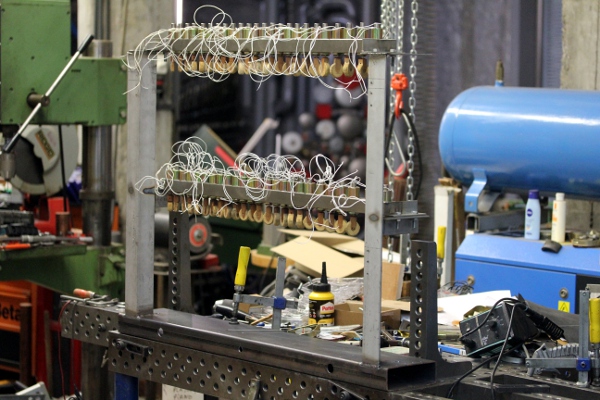 Faze 2:
met wielen op as van 20 mm en gemonteerde celesta modules: .
Faze 2:
met wielen op as van 20 mm en gemonteerde celesta modules: .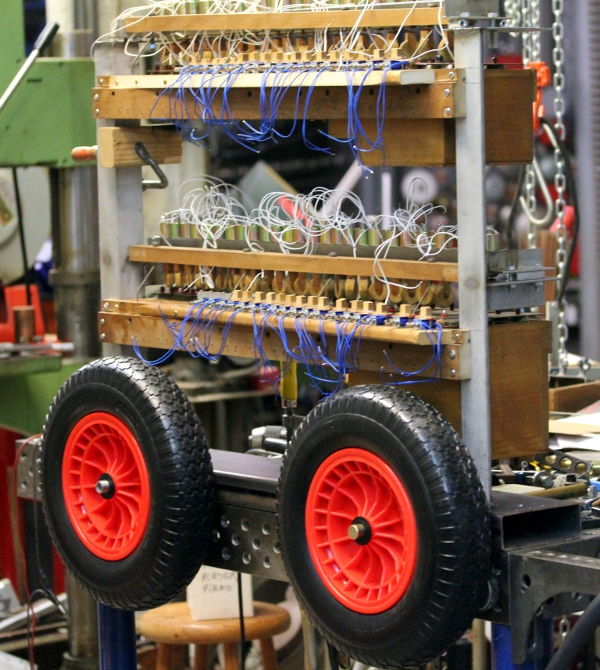 Ook
de voeding met verzadigde tranformator stabilisatie monteerden we op het onderste
kokerprofiel. De hele montage is nu evenwel zo zwaar dat we de konstruktie
niet meer zonder hulp van de lastafel af kunnen halen.
Ook
de voeding met verzadigde tranformator stabilisatie monteerden we op het onderste
kokerprofiel. De hele montage is nu evenwel zo zwaar dat we de konstruktie
niet meer zonder hulp van de lastafel af kunnen halen.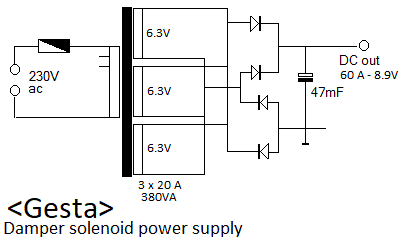 Hoog tijd
nu om werk te maken van de vijf nodige PCB's...
Hoog tijd
nu om werk te maken van de vijf nodige PCB's...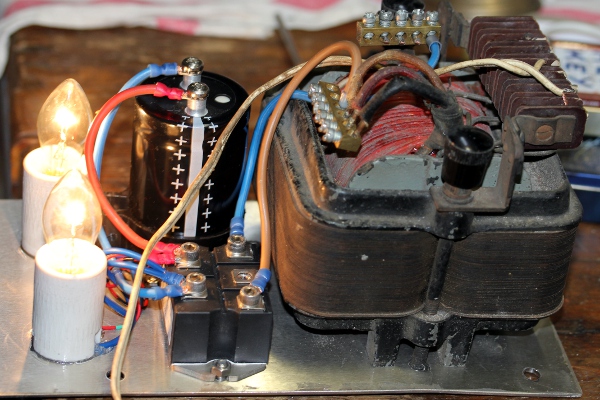
 We gebruikten een
stevige gelijkrichterbrug voor driefazenstroom ooit eens kado gekregen van
Dirk Veulemans.
We gebruikten een
stevige gelijkrichterbrug voor driefazenstroom ooit eens kado gekregen van
Dirk Veulemans.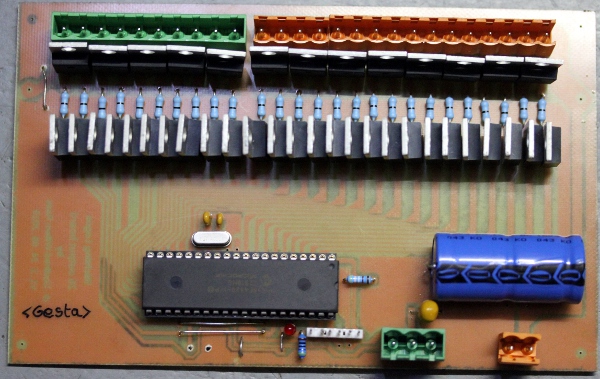
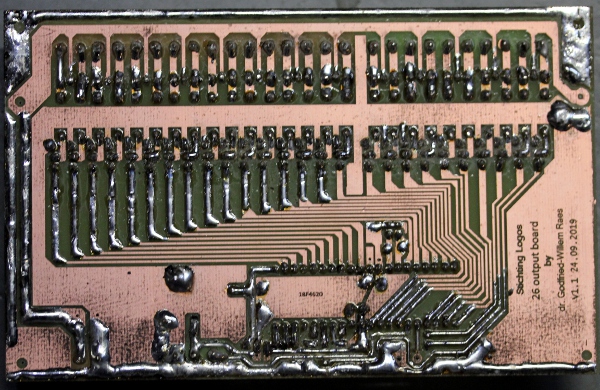 Eerste
hardware test passed. Firmware is voor later. Nieuwe voorraad Bungard fotogevoelige
printplaatjes besteld bij Conrad.
Eerste
hardware test passed. Firmware is voor later. Nieuwe voorraad Bungard fotogevoelige
printplaatjes besteld bij Conrad.| (Terug) naar logos-projekten: | Terug naar Logos' index-pagina: | Naar Godfried-Willem Raes personal homepage... | Naar katalogus instrumenten | |
M&M orkest |
Last update: 2026-10-22 by Godfried-Willem Raes
The following information is not intended for the general public nor for composers wanting to make use of the <Gesta> robot, but is essential for maintenance and servicing of the robot by our clients and collaborators. It also might be usefull for people that want to undertake similar projects.
Technical drawings, specs and data sheets:
Power supplies:
Fuse in the power entry: 6.4 A. A spare fuse can be found in the little drawer on the left side of the IEC entry.
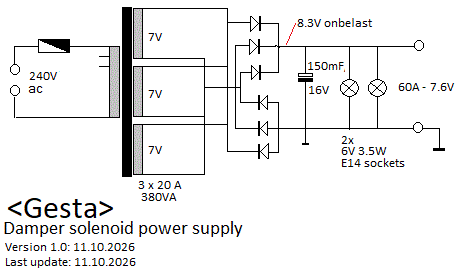
Power supply circuits:
1.: Damper power supply:
2.: Beater power supply:
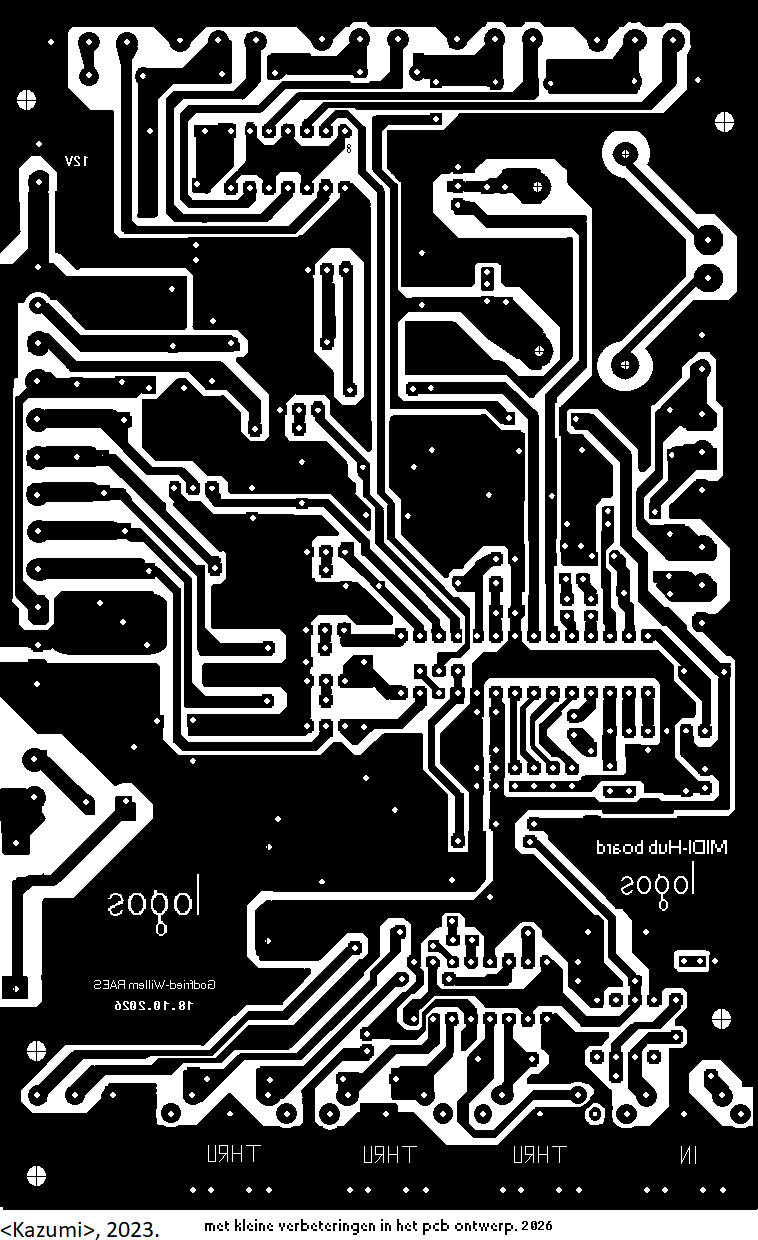
Wiring & circuit details midihub board:
PCB for this board: (This is the same board as used for <Kazumi>.However we have a slightly better version available!).

Circuit details solenoid driver boards: (for these boards, we can use the design previously developed for <Tubo>)


summary of data-sheet values for MOSFET's used:
| type | Umax | Imax | Ug | RdsON | Ci | remarks | |
| IRF3710Z | |||||||
| IRL640 | 200V | 18A | 5V | 0.18 Ohm | 1.7nF | ||
| IRLZ34N | 55V | 30A | 5V | 0.046 Ohm | 880pF |
damperboard 1, out's 1-26 damperboard 2, out's 1-13 |
|
| FQPF20N06E | 60V | 15A | 2.5V | 0.055 Ohm | damperboard 2 , out's 14-21 | ||
| PHP79NQ08LT | 75V | 73A | 5V | 0.014 |
obsolete part damperboard 2, out's 22-26 |
||
| IRL530N | 100V | 17A | 5V | 0.12 Ohm | 800pF |
beaterboard 1 (high) beaterboard 2 (low) |
|
| IRF135 | 135V | 129A | 4V | 0.008 Ohm | 9.7nF | ||
| IRFB3607 | 75V | 80A | 4V | 0.009 Ohm | 3nF |
If repair and replacement is required, all N-channel mosfet's can be replaced with IRL640 types.
Paint and coatings:
Tentative cost calculation:
| tubular solenoids: Lucas Ledex STA |
49
|
63,50-
|
3.112,-
|
| PCB's Pulse boards: |
2
|
350,-
|
700,-
|
| PCB's damper boards |
2
|
300,-
|
600,-
|
| Hub board |
1
|
280,-
|
280,-
|
| Power supply: 9V - 11A |
110,-
|
110,-
|
|
| Power supplies 24V - 6A / 9A |
210,-
|
210,-
|
|
| Konnektors 2pole Weidmueller |
60
|
1,60-
|
96,-
|
| Ettinger M3 shock absorbers |
20
|
3,60-
|
72,-
|
| Rubber fingers |
60
|
2,80-
|
168,-
|
| M6 bakeliet knoppen |
4
|
2,70-
|
10,80-
|
| M3 bakeliet knoppen | |||
| Vilt | |||
| Inox 30 x 30 x 2 | 2 m | ||
| Wielen Masta, 400 mm diameter | 4 | ||
| inox buis 20 mm x 3 mm x 500 | 2 | ||
| stelringen 20 mm inox | 8 | ||
| Material cost estimate |
15.000-
|
Labor (estimated at 16 weeks): 20.000,-
Total estimated cost: 35.000,-
References:
GILLON, Dr.Ir.E, "Elektrotechniek", deel 2 'Elektrische Machines' ed. Standaard Uitgeverij Scriptoria, Antwerpen / Utrecht, 1969 (8e uitgave). Magnetische versterkers worden hierin behandeld: p.149 - 154.
RAES, Godfried-Willem, "Expression control in musical automates", 1977/2026,