|
<Klung> an automated brass anklung 2000 - 2006 - 2015
|
|
|
|
by Godfried-Willem Raes |
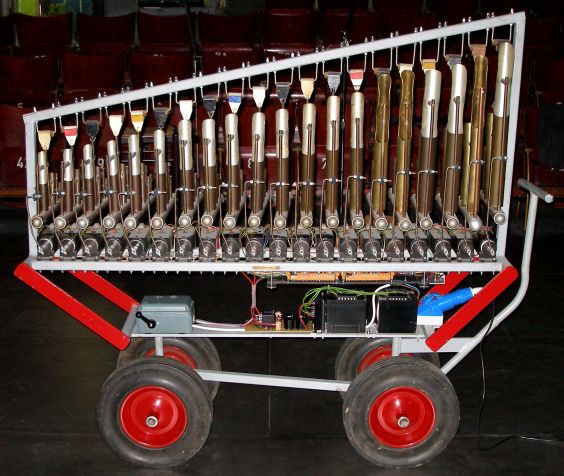
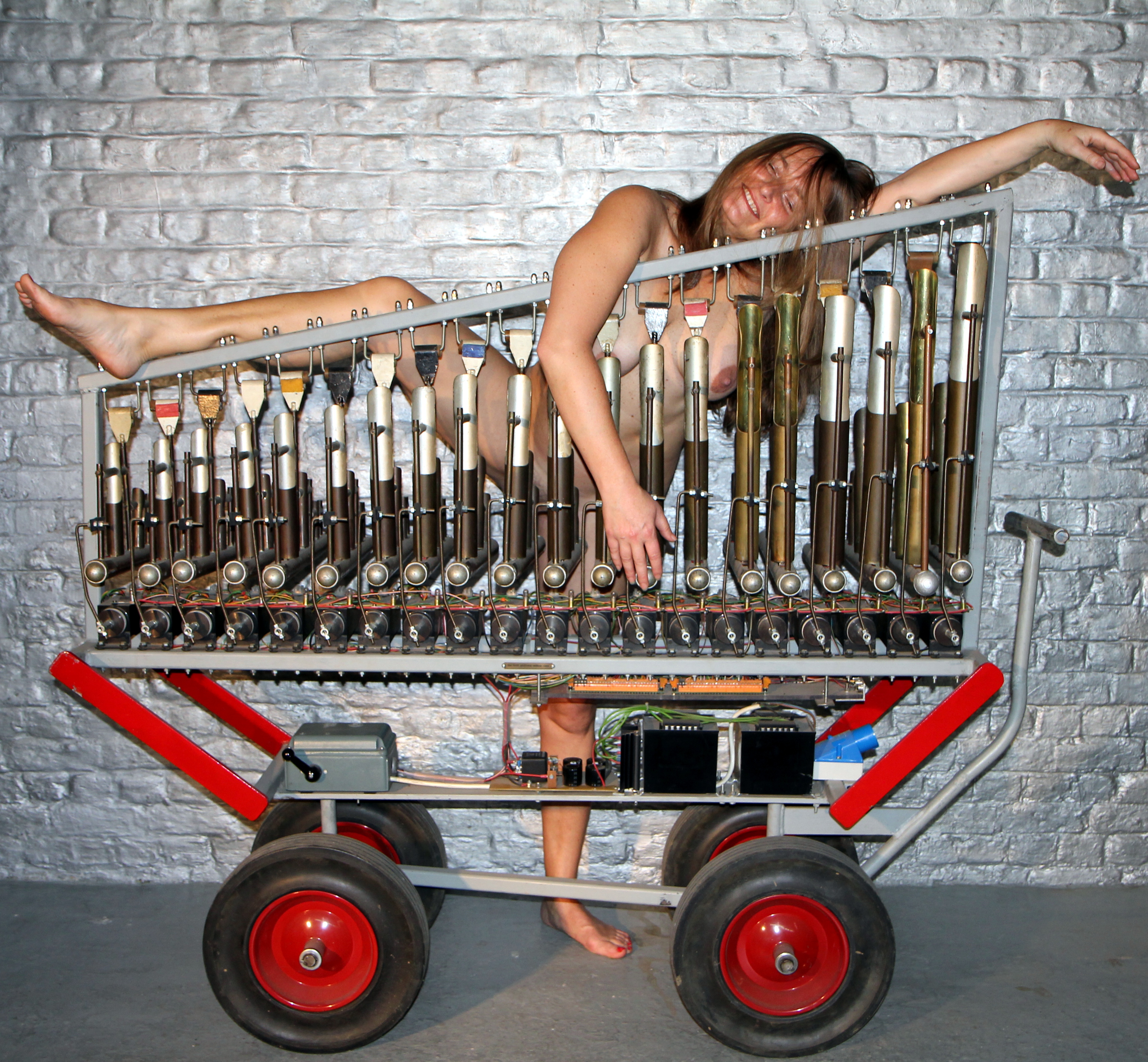
This instrument is a computer controlled acoustical angklung designed and build in 2000. In 2006 it has undergone a major upgrade of the entire hardware and in 2015 the firmware has undergone a major upgrade. The anklungs themselves are made of hardened brass and tuned to a western scale covering two octaves. The instrument can be played by standard MIDI commands. It is mounted on a heavy duty trolley and can be taken on the road for street performances. However, it is not rain resistent and should be protected against moisture. All angklungs are automated by bidirectional hefty solenoids such that the shaking functionallity could be implemented.
<Klung> played its very first automated scales on sunday the 18th of june 2000. Ever since than, it has been a fixed member of the Logos Robot Orchestra.
On june 21th in the year 2000, its builder wrote a tango for this instrument. This composition was called 'KlungelTango' and is scored for <Klung> in combination with a singer or a melodica. The computer program was written in <GMT> and is interactive. The piece can be performed on the street by a single performer. This tango was premiered on monday 4th of july, the melody performed by Karin Defleyt and the tango danced by the author with his partner, Moniek Darge. It was recorded for RTBF-television.
The instrument was made and designed to be a part of the <Slag-Werk> project realized for 'Web Strikes Back' at the occasion of the Tromp biannual, october 2000 in Eindhoven, the Netherlands.
A first composition that became a part the the <Web Strikes Back> project is called 'Klungels'. Both a version for the 'Klung' as a simulator version using real samples recorded from 'Klung' as well as a plain vanilla midi version playing on the robot itself is available for downloading from the Logos website. Work on this interactive software was also done by Kristof Lauwers. The musical range for this robot is:
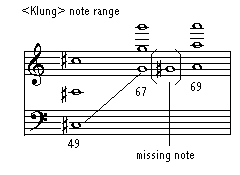
Note that each note sounds in 3 octaves simultaneous. Sound sample of note 60 (C). (.wav format)
Midi implementation table for <Klung>:
Klung responds to messages and commands only on midi channel 4
| Midi command | byte 1 | byte 2 | comment |
| 128 + 4 Note Off | note 49-69 | 0 | note off. Stops shaking. Release is not implemented. |
| 144 + 4 Note On | note 49-69 | velo | note 68 missing, The velocity byte steers the force of the stroke. Strokes alternate direction automatically. |
| 144 + 4 Lights On | note 120-123 | > 0 | lights on/off (4 groups of 5 bulbs each) |
| 160 + 4 Key Pressure | note 49-69 |
shaking frequency 0= off 1 = 2 strokes per second (MM120) |
values 1 to 127 correspond to 2Hz to 16Hz frequencies. In our implementation before 2015, this was only implemented when using the GMT midi file player. Now, since 2015, it became a standard feature of the robot. The command must be sent prior to the note on command. The setting remains sticky until reset by this command, by controller 30 or by a power off command. |
| 176 + 4 Program Change | 0, 122 | - |
program change: select a different velocity lookup table. By default, program 0 will be active. Setting the program to value 122 increases the velocity scaling to a much wider range. |
| 192 + 4 Controller | 30 | global shaking frequency | sets the shaking frequency to the same value for all angklungs. This controller was added to the implementation table in 2015. The range is 2Hz to 16Hz, for midi values 1 to 127. Details of the mapping are in the table below. |
| 192 + 4 Controller | 66 | 0 or >0 | controller: power ON/OFF Power off resets all controllers and settings for shaking frequencies. It also resets the program change to 0. |
| 192 + 4 Controller | 67 | 0 or > 0 | controller: video ON/ OFF for the built-in video camera. |
| 192 + 4 Controller | 69 | 0 or >0 | disable/enable aftertouch shaking control [only implemented when using the GMT file player] This feature is no longer implemented now. |
| 192 + 4 Controller | 123 | 0 | all notes off, no controller resets do occur on reception of this command . It does not reset programmed repetition rates neither. It will also turn off the lights. |
| sysex | used for programming different velocity lookup tables. This feature was dropped in the upgrade from 2015 as there was no longer a use for it. |
The lookup table - a tempered distribution - for the repeat frequencies controlled either globally with controller #30, or on a note-by-note base using the key pressure command for the corresponding note, used is:
| midi value | frequency Hz | MM tempo |
| 0 | no repeats | - |
|
1 |
2 |
120 |
|
2 |
2.066 |
124 |
|
3 |
2.101 |
126 |
|
4 |
2.135 |
128 |
|
5 |
2.171 |
130 |
|
6 |
2.206 |
132 |
|
7 |
2.243 |
135 |
|
8 |
2.28 |
137 |
|
9 |
2.318 |
139 |
|
10 |
2.356 |
141 |
|
11 |
2.395 |
144 |
|
12 |
2.434 |
146 |
|
13 |
2.474 |
148 |
|
14 |
2.515 |
151 |
|
15 |
2.557 |
153 |
|
16 |
2.599 |
156 |
|
17 |
2.642 |
159 |
|
18 |
2.685 |
161 |
|
19 |
2.73 |
164 |
|
20 |
2.775 |
166 |
|
21 |
2.821 |
169 |
|
22 |
2.867 |
172 |
|
23 |
2.914 |
175 |
|
24 |
2.963 |
178 |
|
25 |
3.012 |
181 |
|
26 |
3.061 |
184 |
|
27 |
3.112 |
187 |
|
28 |
3.163 |
190 |
|
29 |
3.215 |
193 |
|
30 |
3.269 |
196 |
|
31 |
3.322 |
199 |
|
32 |
3.377 |
203 |
|
33 |
3.433 |
206 |
|
34 |
3.49 |
209 |
|
35 |
3.547 |
213 |
|
36 |
3.606 |
216 |
|
37 |
3.666 |
220 |
|
38 |
3.726 |
224 |
|
39 |
3.787 |
227 |
|
40 |
3.85 |
231 |
|
41 |
3.914 |
235 |
|
42 |
3.978 |
239 |
|
43 |
4.044 |
243 |
|
44 |
4.111 |
247 |
|
45 |
4.178 |
251 |
|
46 |
4.247 |
255 |
|
47 |
4.318 |
259 |
|
48 |
4.389 |
263 |
|
49 |
4.461 |
268 |
|
50 |
4.535 |
272 |
|
51 |
4.61 |
277 |
|
52 |
4.686 |
281 |
|
53 |
4.763 |
286 |
|
54 |
4.842 |
291 |
|
55 |
4.922 |
295 |
|
56 |
5.003 |
300 |
|
57 |
5.086 |
305 |
|
58 |
5.17 |
310 |
|
59 |
5.255 |
315 |
|
60 |
5.342 |
321 |
|
61 |
5.43 |
326 |
|
62 |
5.52 |
331 |
|
63 |
5.611 |
337 |
|
64 |
5.704 |
342 |
|
65 |
5.798 |
348 |
|
66 |
5.893 |
354 |
|
67 |
5.99 |
359 |
|
68 |
6.09 |
365 |
|
69 |
6.19 |
371 |
|
70 |
6.292 |
378 |
|
71 |
6.396 |
384 |
|
72 |
6.501 |
390 |
|
73 |
6.609 |
397 |
|
74 |
6.718 |
403 |
|
75 |
6.829 |
410 |
|
76 |
6.941 |
416 |
|
77 |
7.056 |
423 |
|
78 |
7.173 |
430 |
|
79 |
7.291 |
437 |
|
80 |
7.412 |
445 |
|
81 |
7.534 |
452 |
|
82 |
7.658 |
460 |
|
83 |
7.785 |
467 |
|
84 |
7.913 |
475 |
|
85 |
8.044 |
483 |
|
86 |
8.176 |
491 |
|
87 |
8.312 |
499 |
|
88 |
8.449 |
507 |
|
89 |
8.588 |
515 |
|
90 |
8.73 |
524 |
|
91 |
8.874 |
532 |
|
92 |
9.02 |
541 |
|
93 |
9.17 |
550 |
|
94 |
9.32 |
559 |
|
95 |
9.474 |
568 |
|
96 |
9.631 |
578 |
|
97 |
9.79 |
587 |
|
98 |
9.951 |
597 |
|
99 |
10.12 |
607 |
|
100 |
10.28 |
617 |
|
101 |
10.45 |
627 |
|
102 |
10.62 |
638 |
|
103 |
10.8 |
648 |
|
104 |
10.98 |
659 |
|
105 |
11.16 |
670 |
|
106 |
11.34 |
681 |
|
107 |
11.53 |
692 |
|
108 |
11.72 |
703 |
|
109 |
11.92 |
715 |
|
110 |
12.11 |
727 |
|
111 |
12.31 |
739 |
|
112 |
12.52 |
751 |
|
113 |
12.72 |
763 |
|
114 |
12.93 |
776 |
|
115 |
13.14 |
789 |
|
116 |
13.36 |
802 |
|
117 |
13.58 |
815 |
|
118 |
13.81 |
828 |
|
119 |
14.03 |
842 |
|
120 |
14.27 |
856 |
|
121 |
14.5 |
870 |
|
122 |
14.74 |
885 |
|
123 |
14.98 |
899 |
|
124 |
15.23 |
914 |
|
125 |
15.48 |
929 |
|
126 |
15.74 |
944 |
|
127 |
16 |
960 |
The instrument uses following dedicated hardware:
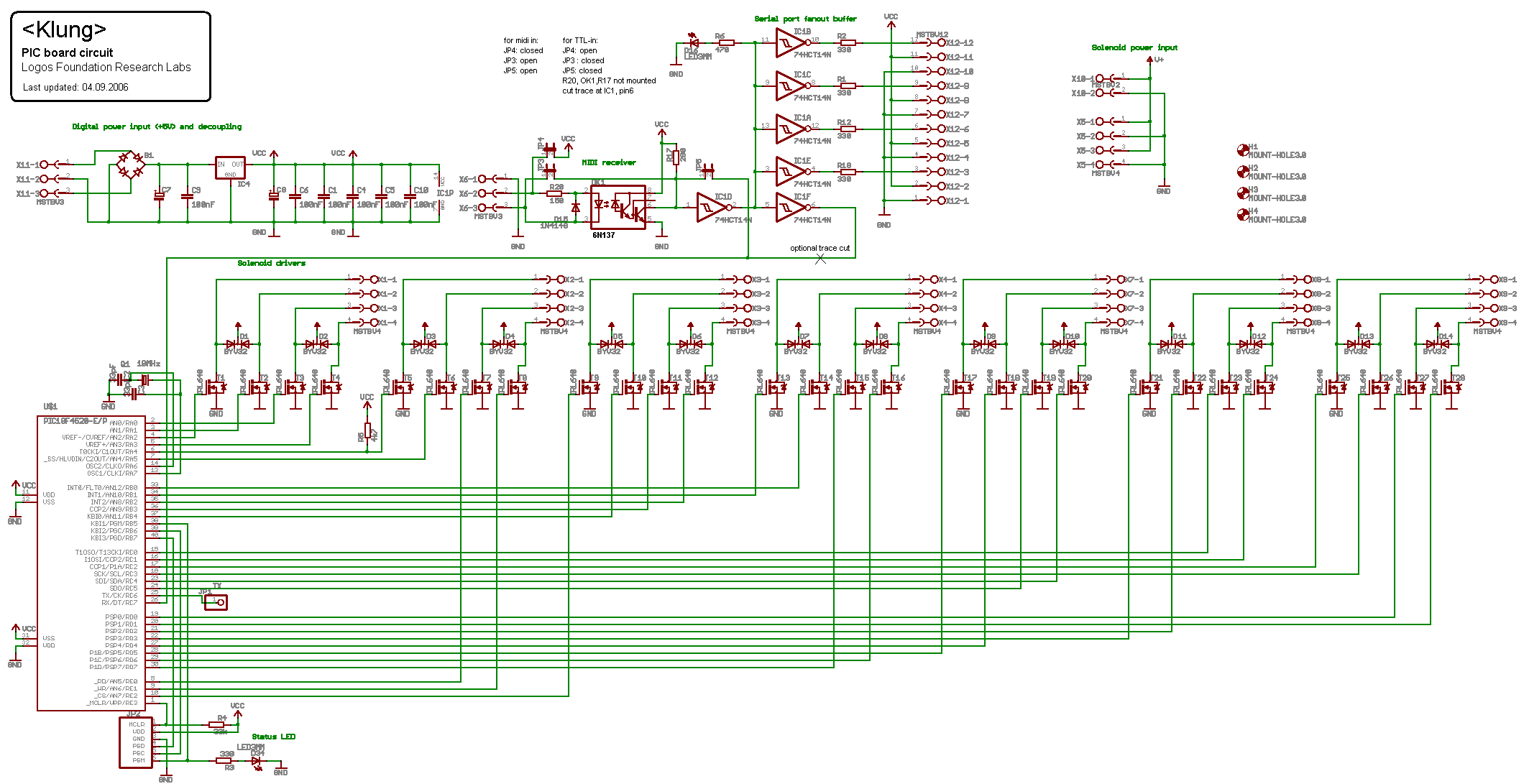
1. two PIC (18F4620) controlled mosfet driver boards taking input from a midi port on a PC, with following schematic:
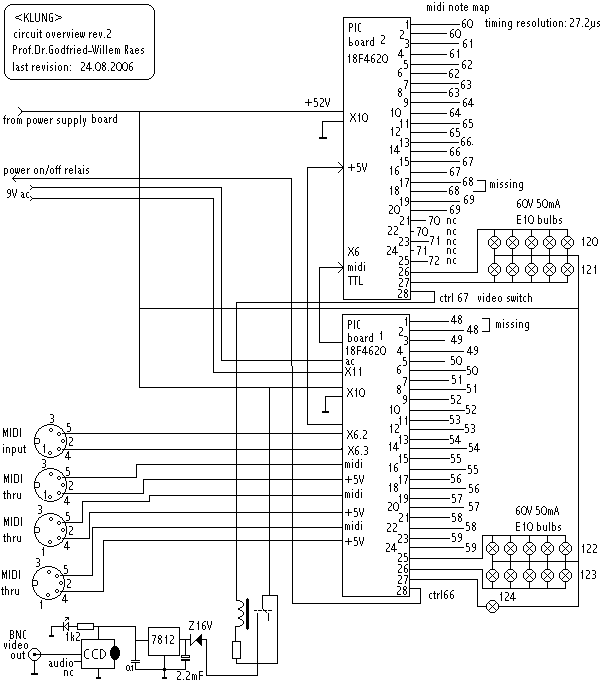
Detailed circuit of the PIC-boards themselves can be seen by clicking this link. Note that the solenoids we used have double windings, one winding for each direction of movement. Thus no return springs are mounted. The alternation of the movement is automatic and handled in the firmware.
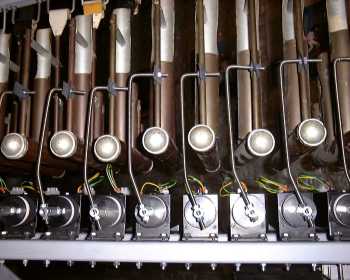
There are 20 anklung-notes in the intrument, each note always sounding in 3 octaves, as usual on the original indonesian instruments, made of bamboo. Our anklung however does not use bamboo but brass tubing and was rebuild from an old German instrument designed to be used in the circus. The original instrument was to be used by a musical clown and even had small electric lights fitted. (During our upgrade in 2006 we fitted tungsten lights again). This use explains why the tuning of the instrument conforms to A=440Hz and why it is tuned in equal temperament. The ambitus is C#- A(49 - 69). The angklungs are actioned by strong bidirectional solenoids. These are rated nominally 24V/ 1A delivering a force of 24 Newton. In order to get a higher range of striking velocities, we operate these solenoids at a little more than twice the rated voltage, limiting the duty cycle to 25%. At these voltage levels, one should never leave the coils under current. Doing this has no musical advantages nor uses and may only lead to an early death of the solenoids or the power supply. Since the rebuild in 2006 it became actually almost impossible for users to do this. The only potentially dangerous thing could be to send notes faster than the instrument can react to. In such a case the instrument would not sound a note but may still get very hot.
2. The 40 power mosfets we
used for controlling these solenoids are Harris RFP10N12L (or the modern
equivalent IRL640), since these switch on TTL levels and are capable of
dissipating 60Watts. The current rating is 17A and their Uds limit is
200V. The rather high gate capacitance (1200pF) is not a real problem
since switching speeds in this application are inherently pretty slow.
For this reason we did not fit a resistor between
gate and ground in the driver circuit. 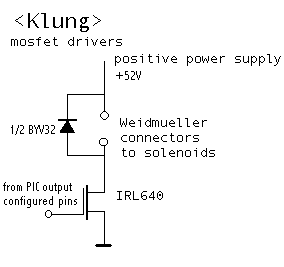 Note
that when the power supply is switched on, all PIC outputs could go to
a high state, thus sounding all notes at the same time. This is a detrimental
condition of course. To avoid this, we modified Klung such that the instrument
has to receive an explicit power on command (midi controller 66) from
the connected PC before it will be fully powered on. In the 2006 implementation,
the PIC's take care of all these technicalities, but still switching the
instrument fast on and off using the power switch can be dangerous and
should be avoided. The midi implementation is as follows:
Note
that when the power supply is switched on, all PIC outputs could go to
a high state, thus sounding all notes at the same time. This is a detrimental
condition of course. To avoid this, we modified Klung such that the instrument
has to receive an explicit power on command (midi controller 66) from
the connected PC before it will be fully powered on. In the 2006 implementation,
the PIC's take care of all these technicalities, but still switching the
instrument fast on and off using the power switch can be dangerous and
should be avoided. The midi implementation is as follows:
- Note ON commands (144+channel, notebyte,velocity) on the selected channel for the notes 49 to 69 toggle the angklungs either forwards or backwards. The velocity controls the striking force and corresponds to the electrical pulse durations. With the default setting for program change set to 0, the range is 7 to 25 ms. With program change set to 122, the range becomes 1.2 ms to 55 ms.
- Note Aftertouch command can be used to set a periodic shaking frequency for the playing note. The command is 160 + channel, notebyte, period. The period is a value between 1 and 127 and is converted to 2 Hz to 16 Hz.
- Note OFF command switch notes off ,also when key pressure commands were sent. When key pressure commands are not used, it is not strictly essential to send note off commands.
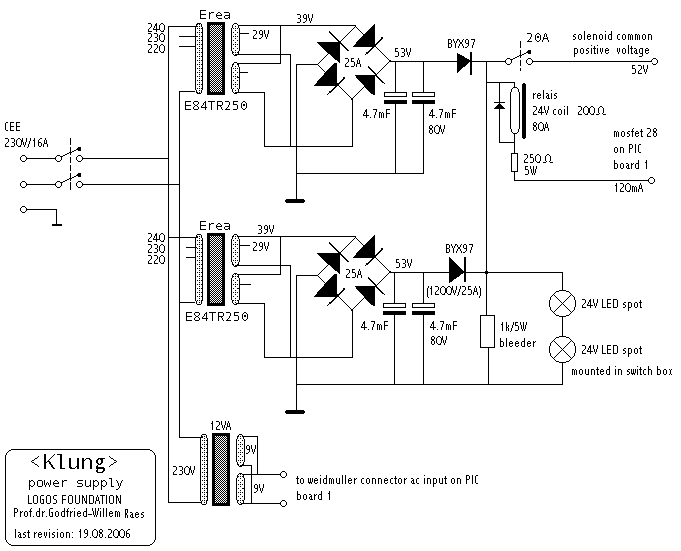
3. The power supply for this instrument is rated for 500 Watts. The only reason for using two transformers had to do with the availability of off the shelve transformers in our regular electronic hardware retail store. The 5V required for the logic circuits is derived from a separate small 9V transformer. The relais works under command of midi controller 66 and is a heavy duty truck- type encapsulated relais rated for 80A. The resistor in series does get hot indeed...
Music:
Specific compositions for this instrument are written by Kristof Lauwers, Brent Wetters, Thomas Smetryns, Kris De Baerdemacker, Charlemagne Palestine, Sebastian Bradt and myself. We herewith invite any composer interested, to submit a piece for <Klung>. The midi implementation is as follows:
To shake the anklungs: notes 49 to 69, the shaking direction will alternate automatically. Note that note 68 (G#) is missing in the instrument. You should limit the shaking speed to lower than 12 beats a second. Velocity is implemented, so you can do crescendo's, accents etc... Obviously the instrument is intrinsically shaky in a very reliable way...
If you are using <GMT> under Power Basic, you can use all specific hardware control functions and procedures provided in our library. The low level functions can also be used by C programmers, since they are exported and reside in a standard DLL library. It is also possible to controll <Klung> using a microcontroller or even a simple Basic Stamp: the BS2 stamp just works nicely. In can output midi directly. Of course Arduino boards just as about any modern microcontroller board can also be used.
Available compositions and/or arrangements for <Klung>:
- 'KlungelTango' by Godfried-Willem Raes
- 'Klungels' by Godfried-Willem Raes
- 'StochKlung' by Kristof Lauwers
- "To Brent 2" by Thomas Smetryns
 Click
here to hear this piece in MP3 format:
Click
here to hear this piece in MP3 format:- "Trio Paradiso" (for Klung, Harma and Vibi) by Godfried-Willem Raes .
- "Paradiso" (for <Vibi>,<Klung>,<Harma>,<Piperola>,<Player Piano>,<Troms>
- "GestroMetals" (for <Belly>,<Klung>,<Vibi> and invisible instrument)
- "Grays for Klung" by Godfried-Willem Raes
- "Rolands Round" by Godfried-Willem Raes
- "Klungel Harm" by Godfried-Willem Raes
Concerts where <Klung> could be heard:
- Sunday 10th of september 2000, Kasteelpark Melle, Brusselsesteenweg (near Gent).
- Tuesday 17th of october 2000: Logos Tetrahedron: Try out concert
- Tuesday 24th to Sunday 29th of october 2000, Eindhoven, TU: <Web Strikes Back Project>,(Netherlands)
- Thursday august 2nd 2001, Ghent: Logos Tetrahedron
- Sunday september 9th 2001, Sint Truiden, Stadhuis (10u00-18u00)
- Thursday october 27-29 2001, Tourcoing, Le Grand Mix (France)
- Monday november 12th 2001, Amsterdam, Paradiso (Netherlands)
- Saturday december 1th,2001, Herne, Teutoburgia Halle (Germany)
- Tuesday december 4th, 2001, Ghent, Logos Tetrahedron
- March 27th, 2002, Ghent, Logos Tetrahedron (M&M ensemble)
- April 23th, 2002, Ghent, Logos Tetrahedron (M&M ensemble)
- July 20th,21th and 22nd, 2002, Ghent, Logos Tetrahedron (M&M ensemble)
- August 10th and 11th, 2002, Ghent, Paterholfeesten, Oudburg
- August 12th, 2002, Ghent, Logos Tetrahedron (M&M ensemble)
- November 28th, 2002, Enschede, Tart Symposium (M&M ensemble)
- December 19th, 2002, Ghent, Logos Tetrahedron (M&M ensemble)
- Februari 13th, 2003, Ghent, Logos Tetrahedron (M&M ensemble)
- March 13th, 2003, Ghent, Logos Tetrahedron (M&M ensemble)
- October 2003, Den Haag, Festival De Branding (M&M ensemble)
- January 2004, Den Haag, Korzo Festival (M&M ensemble)
- January 2004, Lille, Lille 2004 Robots (M&M ensemble)
- April 2004, Paris, France (M&M ensemble)
- March 2005, Leuven, Stuk (M&M ensemble)
- July 2005, Muenchen ,Germany (M&M ensemble)
- August 2005, Ruemlingen Festival ,Switserland (M&M ensemble)
- October 2005, Leuven, Transit Festival (M&M ensemble)
- December 2005, Ghent, Logos Tetrahedron (M&M ensemble)
- March 2006, Ghent, Logos Tetrahedron (M&M ensemble)
- November 2006, Koeln, Gimik, (M&M ensemble)
- November 2006, 's Hertogenbosch, Netherlands (M&M ensemble)
- July 2007 , Spiegeltent Gentse Feesten, Baudelopark (M&M ensemble)
- March 27th 2009: Gent Scheppende Stad: (Vooruit)
- almost all Logos robot orchestra concerts at Logos Foundation
Collaborators on the construction and maintenance of <Klung>:
- Kurd Vandevelde
- Moniek Darge
- Xavier Verhelst
- Sebastian Bradt
Collaborators on the <Klung> software:
- Kristof Lauwers (GMT application coding)
- Johannes Taelman (PIC version 2006), the newest firmware version (2015) was written by Godfried-Willem Raes.
Dimensions and technical specifications:
- width: 1650 mm (with handle, 1750mm)
- height: 1600mm
- depth: 52 0mm
- weigth: 150kg
- power consumption: 512Watts (peak) / 230V AC. Normal average power taken up when playing: 75W. At rest: 20W.
- data input:. Since 2006 <Klung> is provided with a standard midi port.
- data output: 3 midi thru connectors are available.
- Insurance value: 18.500 Euro.
The <Klung> robot can be heard on the Logos Public Domain CD <Automaton> (LPD007)., as well as -in combination with many more automats in CD <M&M> (LPD008). It is also featured on LPD0014: <Robodies> (2005)
| Back to Web Strikes Back | Back to logos' main index page | To homepage Godfried-Willem Raes | Back to the users manual for the robot orchestra |
Last update: 2023-10-05